
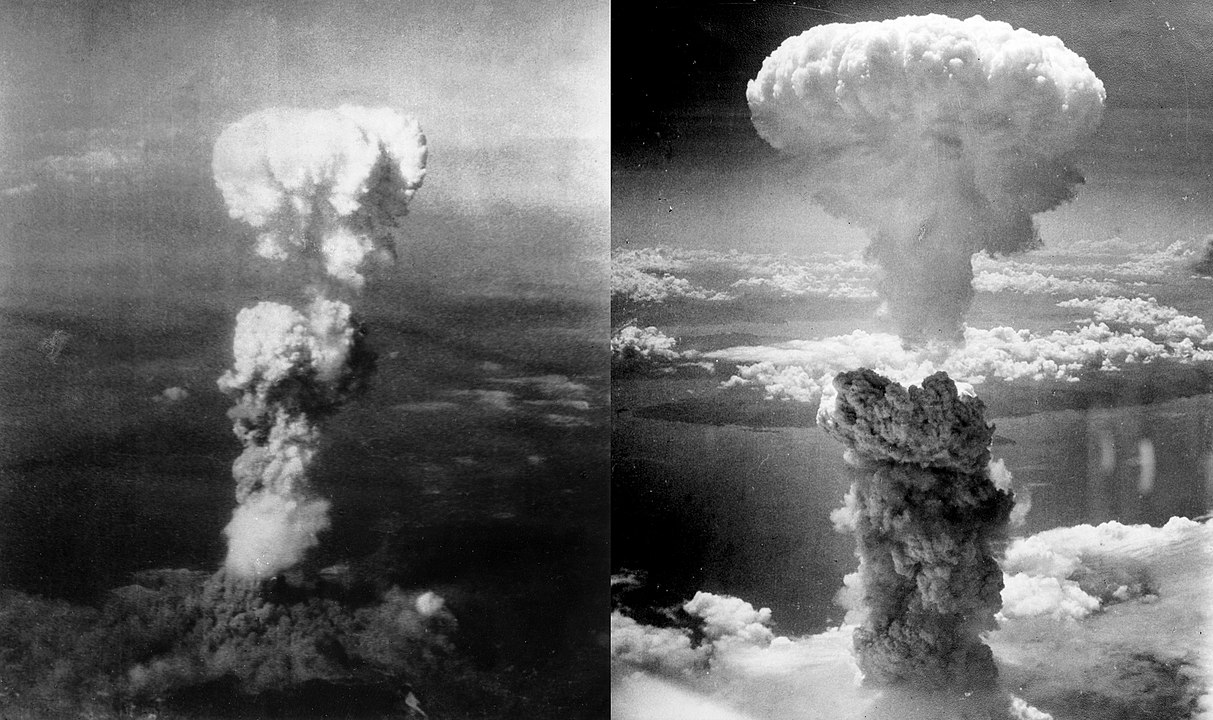
Left picture : At the time this photo was made, smoke billowed 20,000 feet above Hiroshima while smoke from the burst of the first atomic bomb had spread over 10,000 feet on the target at the base of the rising column. Six planes of the 509th Composite Group participated in this mission: one to carry the bomb (Enola Gay), one to take scientific measurements of the blast (The Great Artiste), the third to take photographs (Necessary Evil), while the others flew approximately an hour ahead to act as weather scouts (08/06/1945). Bad weather would disqualify a target as the scientists insisted on a visual delivery. The primary target was Hiroshima, the secondary was Kokura, and the tertiary was Nagasaki. Right picture : Atomic bombing of Nagasaki on August 9, 1945, taken by Charles Levy.
Millions of fatalities projected in Cold War conflict scenarios, but military and civilian leaders showed “reluctance to accept or cause large numbers of deaths” Key internal analyses over the years concluded nuclear weapons would not compel the USSR to surrender and that a nuclear war could never produce a “winner”
Washington, D.C., July 14, 2022 – For decades starting in the late 1940s, influential internal U.S. government analyses provided civilian and military leaders with staggering estimates of likely casualties in a nuclear conflict with the Soviet Union, but the sheer scale of those projected fatalities kept the reports classified until after the end of the Cold War.
Apprehensions over escalation risks involved with the current Ukraine war have brought the issue of potential casualties, even from possible limited Russian nuclear strikes, back to the forefront of public attention even though averting a superpower conflict is a high White House priority.
To put the problem of nuclear casualty estimates in broad perspective, today’s posting of almost two dozen high-level White House, State, Defense, CIA, and other records features a broad range of the fatality estimates and related information U.S. strategists produced from the late 1940s into the late 1970s.
Examples include the landmark Harman Report from 1949 which was the first to spell out (massive) casualty projections while also predicting that resorting to nuclear weapons would not force the Kremlin to capitulate. A 1964 report to JFK approximated 134 million American and 140 million Soviet deaths from a theoretical superpower nuclear exchange. Carter administration reports on the famous PRM-10 (assessing U.S. national strategies and capabilities) candidly admitted that a nuclear war could never have a “winner.”